

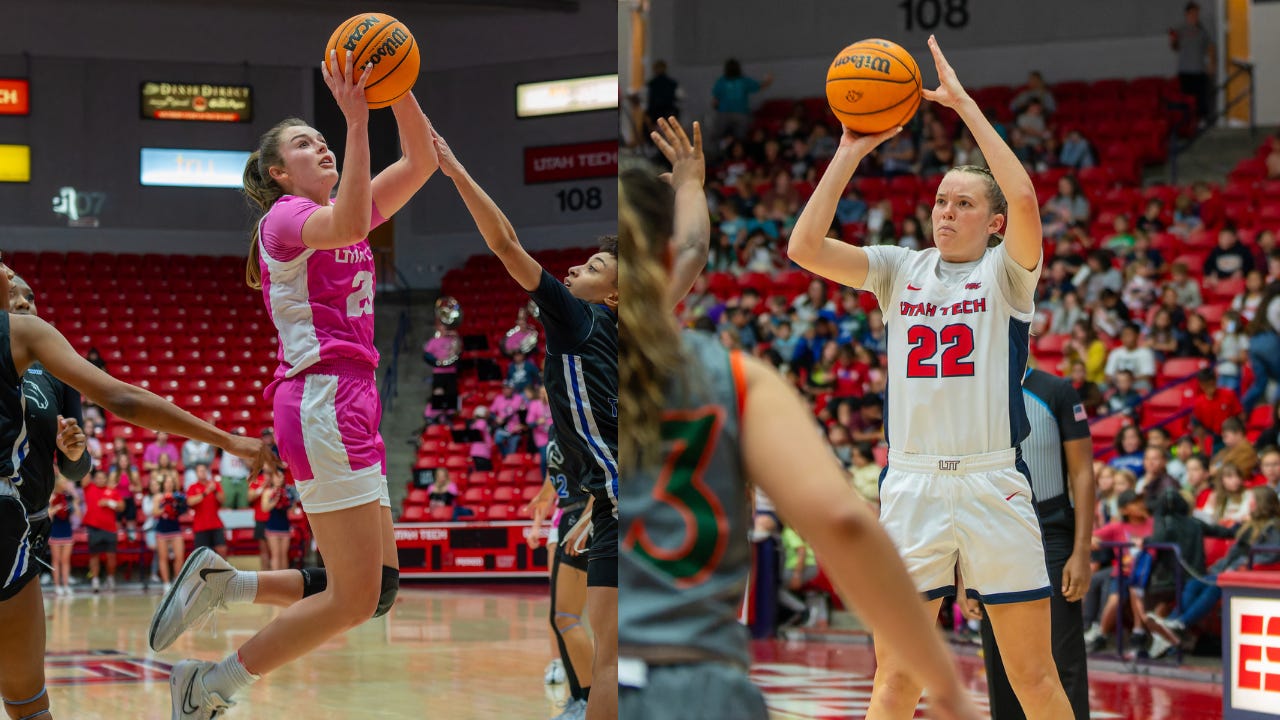
Before they were assistant coaches, before their names climbed to the top of the Utah Tech Trailblazers record book, Breaunna Gillen and Emily Isaacson, now Chamberlain, after getting married September 20, 2024, were simply competitors who believed in something that didn’t yet fully exist.
Now, they’re back at Utah Tech — not as players rewriting history, but as coaches guarding it.
“It is so much more stressful than being a player,” Gillen admitted with a laugh. “When I was on the court, I could control the game. I could shoot it, defend, and make plays. Now I’m pretty much just watching. I can make adjustments and tell them things, but they’re the ones who have to deal with it. I don’t have control anymore — and that’s the hardest part.”
Chamberlain, who played as recently as last season, sees it from a different angle.
“You don’t really know what your coaches go through until you walk the walk,” she said. “It makes me 100 times more grateful for them. But it’s been cool because we were just in that position. I feel like we can touch them in a way or bond with them in a way because we can relate.”
That relatability matters.
Because no one understands Utah Tech’s rise quite like Gillen and Chamberlain.
Record Holders — and Program Builders
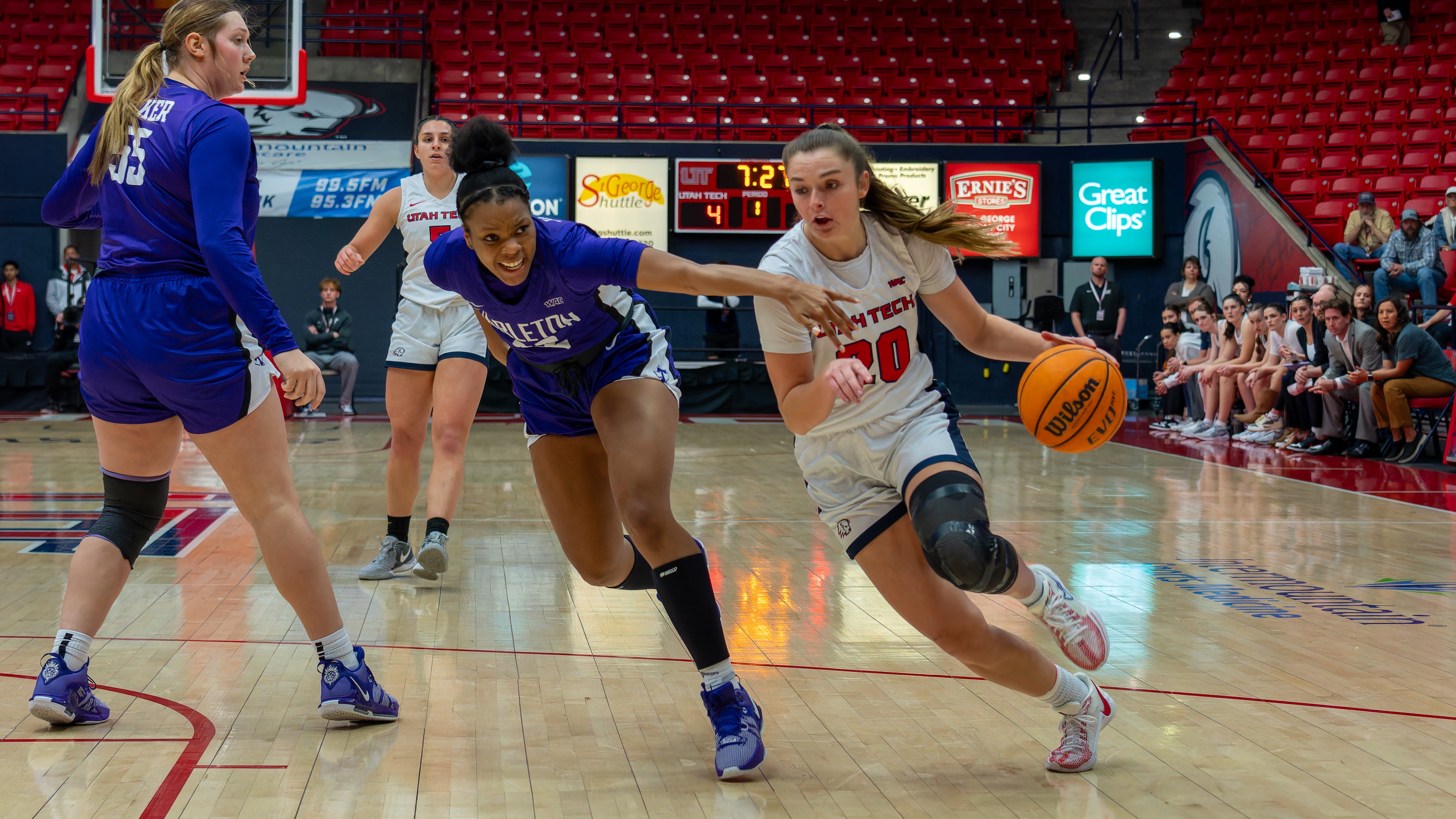
Gillen sits atop Utah Tech’s all-time scoring and assists lists — a rare dual achievement that reflects her ability to both take over games and elevate teammates.
Chamberlain holds the program records for three-pointers made and three-point percentage, the most efficient long-range shooter in school history.
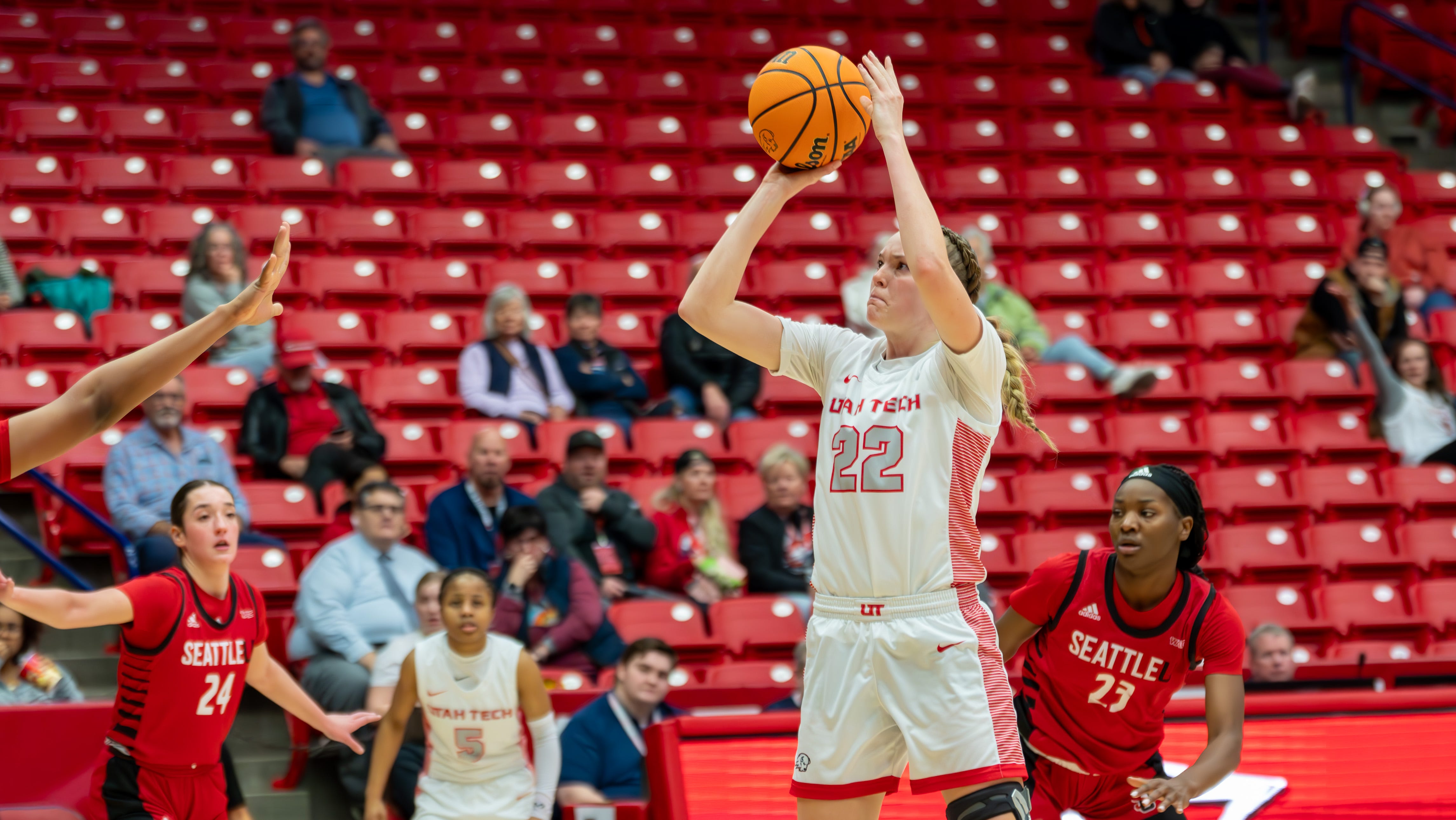
Both scored more than 1,100 career points. Both grabbed more than 500 rebounds. Neither was one-dimensional.
But their legacy is bigger than numbers.
They, alongside Maggie McCord, were foundational pieces during Utah Tech’s transition from Division II to Division I — a leap that requires patience, sacrifice, and belief before wins follow.
“We all made the decision on our own,” Chamberlain said of the trio committing to what was then Dixie State. “But once we were all signed, we were like, we’re a team.”
Gillen remembered the recruiting process vividly.
“JD was one of the only ones who was like, ‘I want you here.’ Other places were kind of like, ‘Maybe we have a spot.’ You want to go where you’re wanted. And he gave me that shot.”
For Chamberlain, it was culture.
“I remember standing in the Burns Arena on my visit and telling my parents, ‘I’m coming here.’ I didn’t commit right then, but I knew. The culture JD creates — it’s family. It’s home away from home. That mattered to me.”
They committed to a vision. And then came the chaos.
Injuries, COVID, and the What-Ifs
The transition years weren’t smooth.
There were injuries — devastating knee injuries that became a recurring theme for the program. There was COVID, which shut down Utah Tech’s first Division I season after just three games.
“It was heartbreaking,” Chamberlain said. “You want to play. That’s why you’re here. And when it gets taken away from you, it’s really hard mentally and emotionally.”
For her, the pain was compounded. She lost significant time to injuries across multiple seasons.
“It was two years in a row where I didn’t really get to play,” she said. “That sucked.”
Gillen’s experience was similar.
“We had made it through preseason — which is the hardest part — and we were finally playing games,” she said. “And then it just gets cut off. It was frustrating. It was sad. But looking back, I think we grew a lot.”
The injuries lingered beyond COVID.
“It feels like a recurring nightmare,” Gillen said. “The what-ifs are always there. But if you get stuck living in that, it’s not the best way. We were proud of how we finished with the circumstances.”
Chamberlain remembers watching from the sideline during one of those injury-plagued seasons.
“I just felt so sad that I couldn’t even help them. I just wanted to give them a break from their minutes. You feel helpless. The only thing I could do was focus on my rehab.”
And yet, even in the what-ifs, growth happened.
“One of JD’s favorite things is he always says we’re going to take a bad situation and flip it on its head,” Chamberlain said. “I feel like we’ve done a good job of that.”
The Breakthrough
The payoff came in 2023.
Utah Tech defeated rival Utah Valley in the WAC Tournament — the program’s first-ever conference tournament win at the Division I level.
For a team that had endured injuries, shutdowns, and skepticism, it was validation.
It wasn’t just a win. It was proof they belonged.
The victory over Utah Valley wasn’t symbolic alone — it was historic. It marked the program’s 19th win of the season, the most in Utah Tech’s Division I era at the time, and it set a new standard for what the Trailblazers could accomplish at the highest level.
The trio of Gillen, Chamberlain, and McCord had carried the program through its transition years. That night felt like arrival — not just emotionally, but statistically and structurally. It raised the bar.
Nineteen wins. A tournament breakthrough. A rivalry statement.
For a program learning how to compete at Division I, that moment didn’t just celebrate progress.
It demanded more.
A year later, the Trailblazers posted their best finish in the WAC, fourth place with a 12-8 mark.
That was good enough for an opening round bye at WAC Vegas before falling against UT Arlington.
Macie Warren missed the last nine games of the year, while Maddie Warren missed that WAC tournament loss after both re-injured their ACLs.
Chamberlain also tore an ACL in the third game of that same season against Jacksonville, as part of the WAC/Conference USA Challenge in Burns Arena.
But still Utah Tech found ways to win, including a historic 92-86 win against Oregon on December 19, 2023, as part of the Trailblazer Classic.
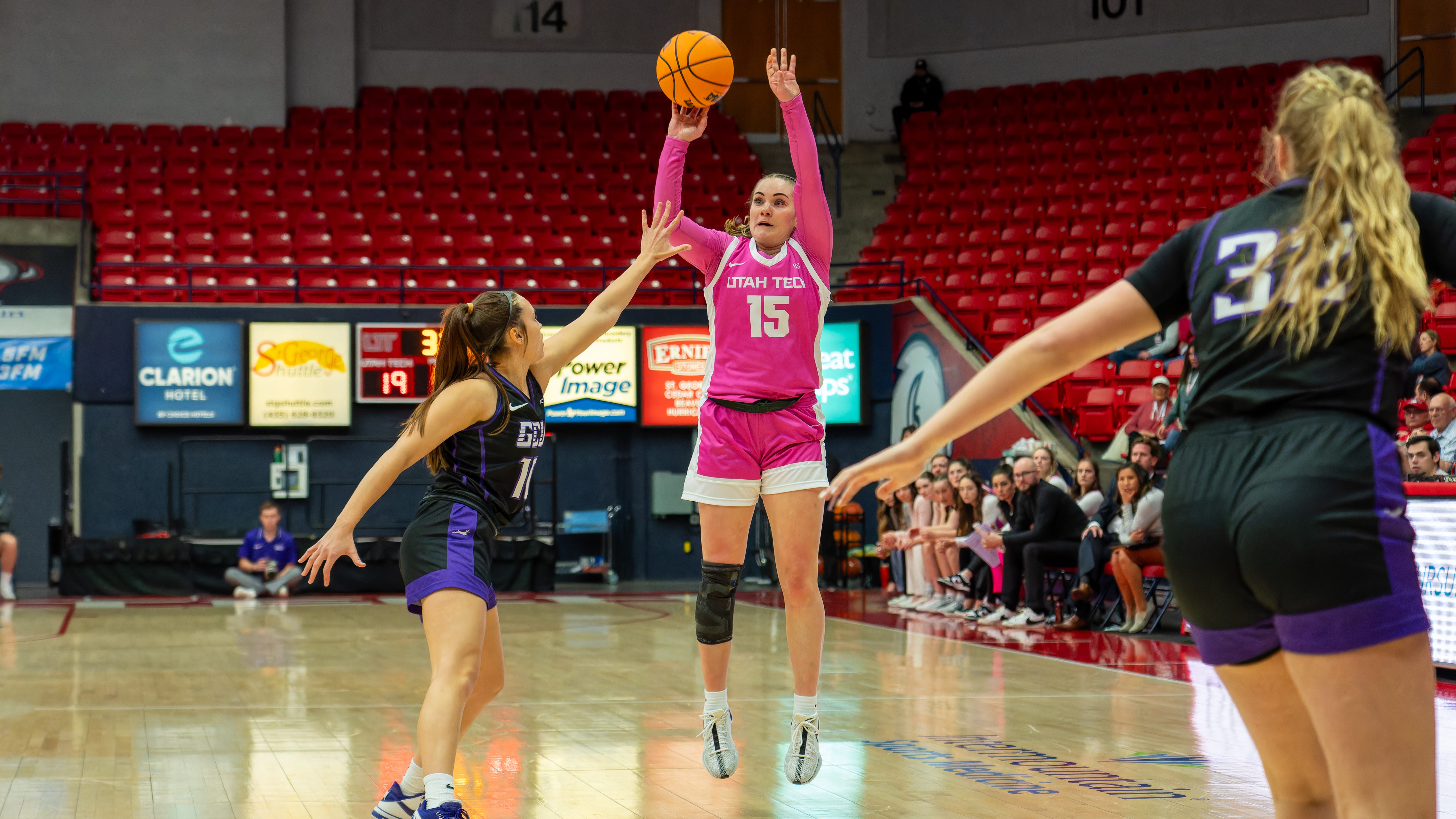
The Trailblazers hit 21 3-pointers.
Gillen posted a triple-double of 17 points, 10 rebounds, and 10 assists.
McCord hit a record-tying eight 3-pointers in that game, which marked the program’s first victory over a power conference program.
That year, in his WAC Vegas press conference, Gustin said that he’s never seen a team show such resilience in his 20+ years of coaching.
He also said that he wouldn’t be surprised to one day see the jerseys of Breaunna Gillen, Emily Isaacson, and Maggie McCord hanging in the rafters of Burns Arena.
From Teammates to Coaches
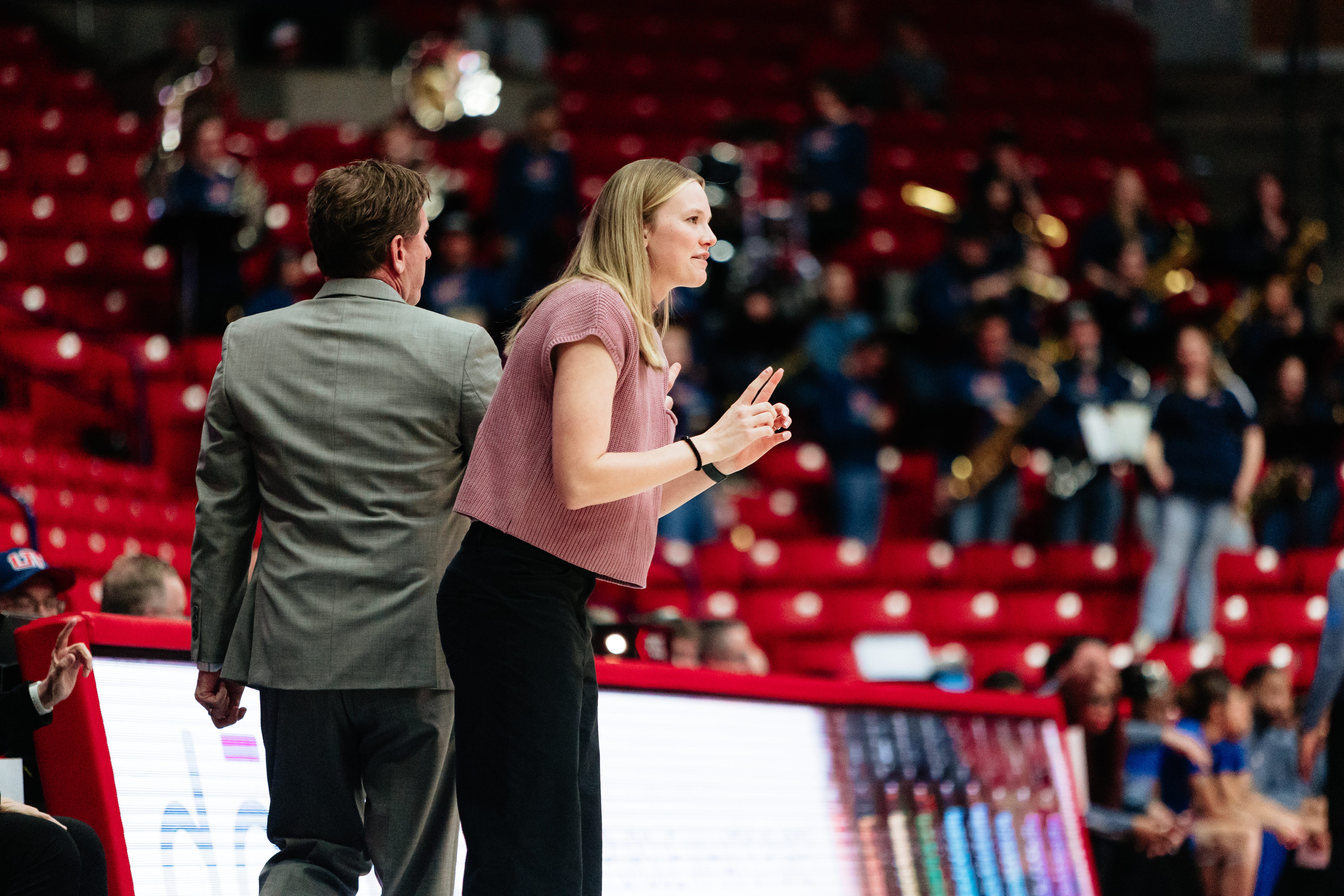
Now, they stand on the sideline.
For Chamberlain, the transition from teammate to coach happened almost overnight.
“I was the only senior. It was my sixth year. I already had that leadership role,” she said. “But I was grateful JD gave me the opportunity. And the girls have been cool with it. There’s a mutual respect.”
Gillen nearly went another direction entirely. She was preparing to apply to PA school when the coaching opportunity emerged.
“I had my application ready,” she said. “And then JD called. Basketball is my passion. Nothing compares to it for me.”
The return felt natural.
“The culture here is amazing,” Gillen said. “They welcomed me with open arms.”
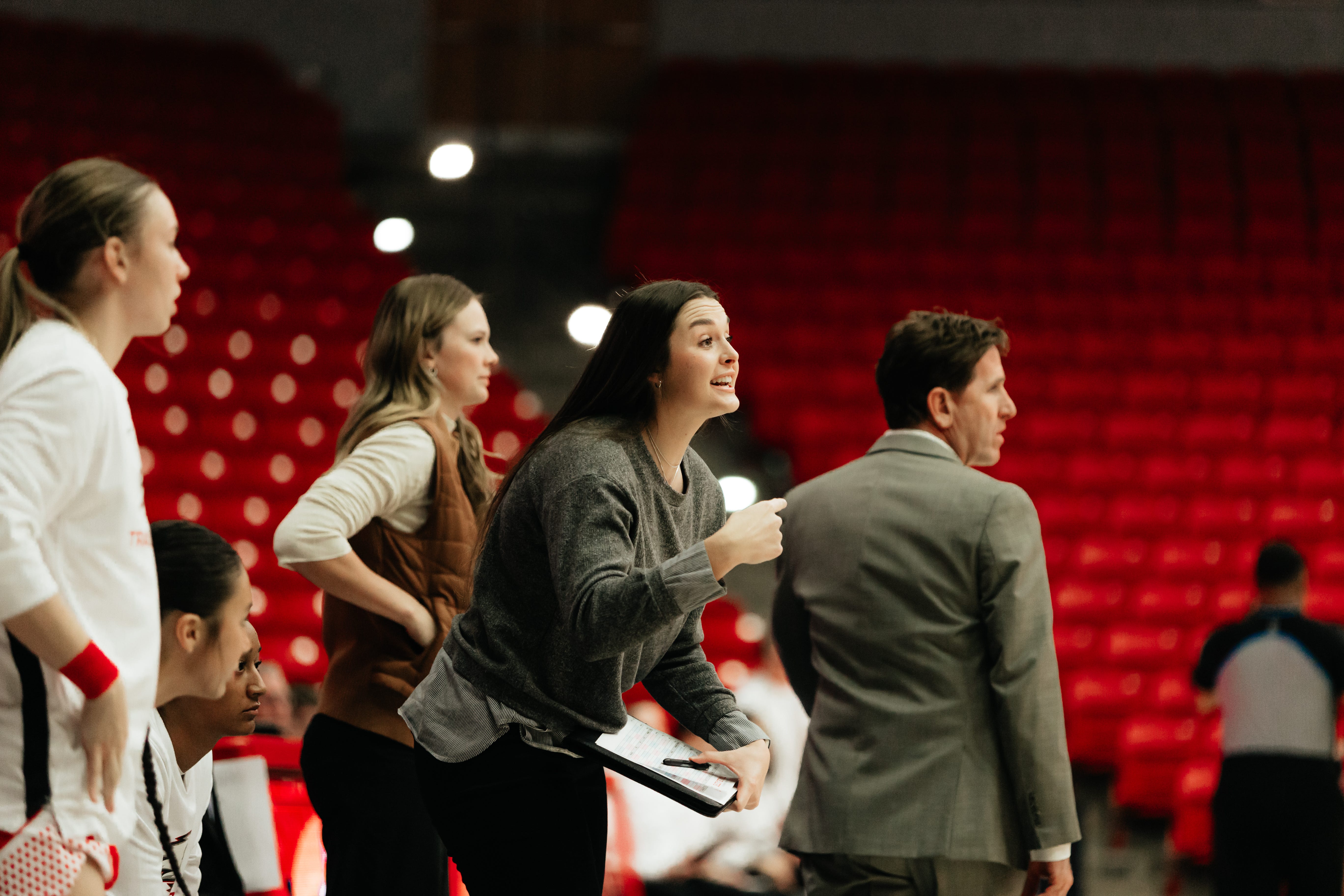
They still jump into practice when needed. They still compete. But the lens has changed.
“I’ve never watched this much film in my life,” Chamberlain laughed. “Now I see it so much better. We were joking — we’re like, ‘We’re sorry if we ever messed up a scout.’ Because it takes so much work.”
And that work deepens their appreciation for what they built.
Full Circle
The numbers will always be part of their legacy.
Gillen — all-time leader in scoring and assists, and top-10 in many other categories
Chamberlain — all-time leader in 3-pointers made and percentage, and top-10 in other categories.
Both — 1,100-plus points, 500-plus rebounds.
But their true imprint is cultural.
They committed when the program was still proving itself.
They endured the transition.
They absorbed the heartbreak of injuries.
They delivered the breakthrough — a 19-win season and the first Division I tournament victory in school history.
Now, they teach the next generation how to handle the same adversity.
They understand what it feels like to sit helplessly with an injury.
They understand the pressure of Division I expectations.
They understand what it takes to flip a bad situation on its head.
Most of all, they understand Utah Tech.
Because they didn’t just play here.
They built it.